We made a tiktok post summarising my last post on JC vs Poly.
There were some distinct camps. One camp argued that poly is better because of the hands-on approach to education.

The other camp argued that JC is still the “Golden Ticket” because, statistically, it offers a smoother path to local Universities (NUS/NTU/SMU).
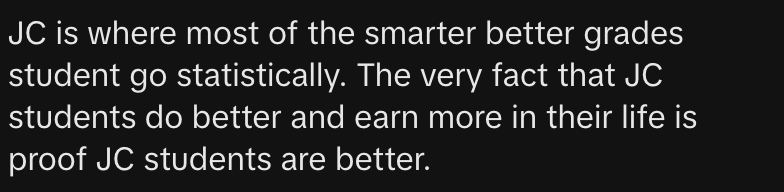
And someone pointed out an apparent “irony” of the education system.

As the O-Level results settle, and you stare at that JAE form, I want to tackle the big question: Is the Junior College route actually still relevant?
In an era where AI can solve H2 Math problems in seconds and write GP essays in minutes, why spend two years suffering? Why not go to polytechnique for hands-on skills? Is going to university still that important?
Here is our take.
1. Yes, JC is a “golden ticket” to University… (for most)
Let’s address the elephant in the room. Critics are right: The statistics still favor JC students for local university admissions. The route is more direct.
-
The Relevance: If your goal is a generalist degree (Law, Business, Humanities) and you need a high probability of entry, the A-Level route remains the most efficient “sorting hat” the system has. It is designed to filter for University readiness.
-
The Caveat: JC is a two-year marathon. If you’re not open to the idea of a rigorous curriculum, on top of the overwhelming commitments that you might want to undertake to boost your portfolio, then there is a chance that you might perform too poorly to go into the University Course of your choice. The first step to success in JC is knowing what you’re signing up for. I cover more in-detail here.
2. The Value in JC Education
This is where the AI argument gets interesting. Yes, ChatGPT has the answers. But the modern economy is starting to devalue “answers” and overvalue “questions.”
JC is a 2-year boot camp in First Principles Thinking.
- In H2 Physics, you don’t just memorize; you derive.
- In Economics, you learn to model complex human behavior.
In fact, for most technical courses in University (Engineering, Medicine, Law etc), the curriculum is much, much more rigorous than A-Levels. At A-Levels, you’re given two years to study for one exam. In University, you study things of much greater depth, and you learn and take an exam once every Semester/ Trimester (depending on which school you study at).
3. The “Suffering” is the Point
I read a comment saying JC is “mental torture.” I won’t lie—it is grueling. But in a world of instant gratification (TikTok, UberEats, ChatGPT), the ability to engage in Delayed Gratification for two years is a superpower.
JC trains “Executive Function”—the ability to plan, focus, and endure when you don’t see immediate results. That skill is more relevant than ever.
4. There is still value in trying to obtain a degree.
I hear a lot of chatter online hypothesizing that “Degrees are no longer useful” and “Skills matter more.”
In the Singaporean context, this is dangerous advice. While skills absolutely matter, we live in an Asian society where credentialism is still the primary filter for HR departments.
The Reality: A degree is no longer a differentiator; it is the entry ticket. It signals to an employer not just what you know, but that you have the “trainability” to complete a rigorous, structured program.
The Value: Skipping the degree route is possible, but it requires you to be exceptional. For the other 99%, the degree is the safety net that prevents you from being underpaid. JC remains the highest probability bridge to that safety net.
Beyond that, with AI changing how things are done, core fundamentals and first principles logic (which are taught in University) are what’s crucial. For example, a common “hot-topic” is software engineering, where “vibe-coding” has replaced entry level roles. However, core fundamentals like Data Structures and Algorithms are still important. In Machine Learning, understanding of concepts like Linear Algebra is still required.
If those words went over your head, just know that **University ingrains fundamental skills that you can build upon in the future. AI is not here to replace rudimentary knowledge.
5. (Opinion) Where the true value of Singapore’s Education System really lies.
Finally, let’s talk about the “System.” People complain that our syllabus is outdated. “Why do I need to know the area of a circle in real life?” They are missing the point. The true value of the Singapore Education System isn’t the content—it’s the Conditioning.
We have one of the most rigorous, high-pressure standardizations in the world.
- It trains Executive Function: The ability to plan 6 months ahead.
- It trains Emotional Regulation: The ability to sit in an exam hall, panic, and then calm yourself down to solve the problem.
- It trains Grit: The ability to do things you hate, for a long time, to achieve a result you want.
- It trains Thinking: The ability structure your words and your thoughts, to convert an abstract concept into something you can comprehend.
And most importantly, to study for high-stakes exams, it takes us Self-Discipline. I wrote about self-discipline here, but essentially, with devices being so distracting, how many of us can put down our devices and focus on the task at hand?
Hence, in however many years time, when global MNCs hire you/ your children, they aren’t hiring because we know the atomic mass of Potassium. They hire us because they subconsciously know we have survived a system that breaks the weak. We are reliable. We deliver.
The education system definitely has its flaws - no system is perfect. However, being on the optimistic side, the education system does have its merits in training us to be great.
The Verdict: JC is not relevant because of the syllabus. It is relevant because it is a gym for your brain. It’s just not the right gym for everyone.