The 70-Point A-Level Reset: A Strategic Breakdown for 2026
The transition from a 90 Rank Point (RP) system to a 70 RP system is one of the most significant changes to the Junior College landscape in a generation. While the Ministry of Education’s primary goal is to “broaden the focus” and reduce the obsession with grades, the mathematical reality for students has shifted.
This year, we saw many students on reddit who had consistently performed for internal exams, but failing to perform at the A-Levels.
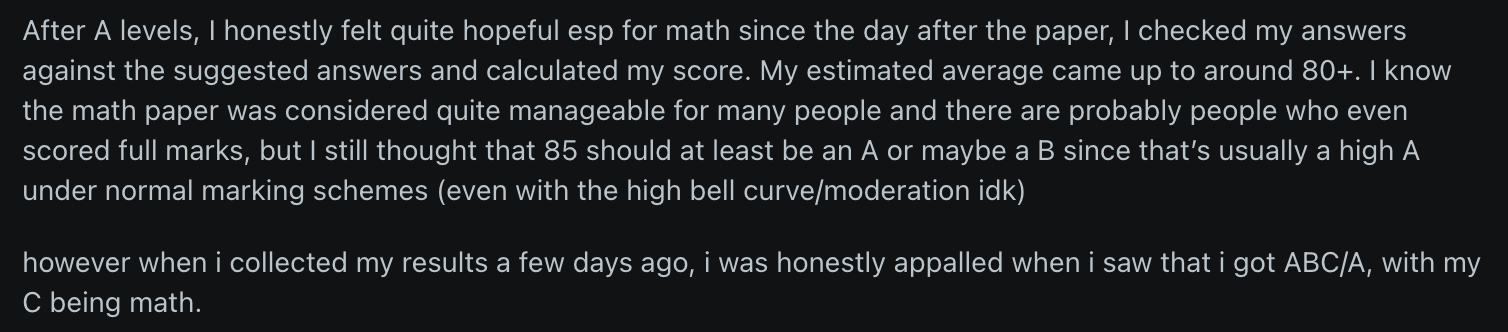
Here is an objective look at how the mechanics of university admission are changing and why the “fewer subjects” approach carries its own set of unique challenges.
1. The Weightage Shift: Core Subjects Get “Heavier”
In the previous 90 RP system, rank points were spread across six components (3 H2s, 1 H1, GP, and PW). In the 70 RP system, the denominator has shrunk, but the value of each H2 remains the same.
- In the 90 RP Era: Each H2 subject accounted for ~22.2% of the total score.
- In the 70 RP Era: Each H2 subject now accounts for 28.6% of the total score.
The Observation: A single-grade drop (e.g., from an A to a B) in an H2 subject now has a larger relative impact on the final score than it did previously. Without Project Work (PW) acting as a weighted “buffer,” students have less room for error in their core content subjects.
2. The “Insurance Policy” of the 4th Subject
Under the new rules, the 4th content subject (usually the H1 or the lowest-performing H2) is only factored in if it pulls the average up. This effectively makes the 4th subject an “insurance policy.”
However, the psychological impact is that many students may choose to “min-max” their effort, focusing exclusively on three H2s and GP. When a large portion of the cohort narrows their focus, the national average for those specific subjects tends to climb, potentially making the distinction curve more competitive.
3. The Rising Stakes of General Paper (GP)
GP has been elevated from a secondary requirement to a core pillar. It now represents 14.3% of the 70 RP total. For students who traditionally leaned on their technical or scientific strengths to “carry” their rank points, the inability to offset a weaker GP score with a strong PW or H1 score is a significant change in strategy.
4. The Potential Bell Curve Problem
When the curriculum “shrinks,” student effort doesn’t disappear; it simply concentrates.
By removing the weightage of Project Work and making the 4th content subject an “optional” bonus, the system has effectively allowed the entire JC cohort to funnel 100% of their cognitive bandwidth into just three H2s and General Paper.
When thousands of high-achieving students spend more hours perfecting the same narrow set of subjects, the national average for raw marks inevitably climbs.
In a moderated system, if the “average” student is now performing at a higher level because they have more time to drill specific topics, the raw score required to secure an “A” grade moves upward.
This creates a high-stakes “ceiling” effect where the margin for error becomes incredibly thin; a few minor “careless mistakes” that might have been forgiven in a 90 RP era could now be the deciding factor between a distinction and a grade drop, simply because the rest of the pack has had the luxury of time to iron out those same kinks.
We are moving into an era where portfolios, interviews, and Aptitude-Based Admissions are no longer “bonuses” - they are becoming the primary tie-breakers for competitive courses like Medicine, Law, or CS.
5. Beyond the Grade: The Era of Portfolio and Co-Curricular Activities
The “perfect score” (70/70) might also become more common due to the removal of PW and the 4th subject from the baseline. The distribution of scores will also decrease.
What might this mean?
Since 2022, applications to universities such as National University of Singapore have expanded to include personal statements and write-up to accompany one’s A-Level results in the application process. From my experience advising ex-students on their applications and helping students without perfect scores to differentiate themselves and get into competitive courses, here’s what I think:
Universities are likely looking elsewhere to differentiate candidates.
Since the intention of shrinking the rank point system was to encourage holistic exploration and development, it is more crucial than ever for the portfolio of students to showcase a narrative of intentionality rather than just a collection of certificates. In a landscape where the academic ceiling is more crowded, your child’s Co-Curricular Activities (CCA) and external projects must pivot from “participation” to “contribution.”
Admissions officers are no longer just looking for a CCA; they are looking for evidence of Leadership (the ability to navigate conflict and drive change), Growth (how a student responded to a specific failure or setback), and Genuine Passion (pursuits that exist outside the syllabus).
A portfolio that stands out is one that connects the dots, showing how a student’s interest in, say, environmental sustainability led them to initiate a recycling pilot or conduct independent research, rather than just joining a “Green Club” for the hours. A student who explored introductory data science to understand how various factors affect the pricing of her favourite items will likely be preferred over the student who never dug deeper into any thing.
However, this level of holistic maturity cannot be “crammed” during the June holidays of JC2.
The cultivation of these non-academic pillars-such as self-discipline, time management, and emotional resilience-must begin much earlier, ideally during the transition from Primary to Secondary school. These “soft skills” are actually the hard foundations of academic success.
For instance, a student who has spent years balancing a competitive sport or a demanding hobby has already built the “grit” required to handle the compressed intensity of the 70 RP system. When we encourage children to explore these areas early, we aren’t just “buffing a resume”; we are building the character traits that ensure they don’t just get into university, but actually thrive once they are there.
My Final Takeaways
While this move may have their supporters and dissidents, and there may be backlash for it (i.e. even more extra-curricular enrichment programs, more intense competition for graded subjects), the decision has been set in stone and we are just uncovering how it affects students.
Instead of bemoaning the move, let’s leverage this to prepare our children for the future - where non-academic capabitlities are more crucial than ever.